
Car hire and driving in Tenerife: rules, costs and what to expect
Updated 29 October 2026 · DoTenerife
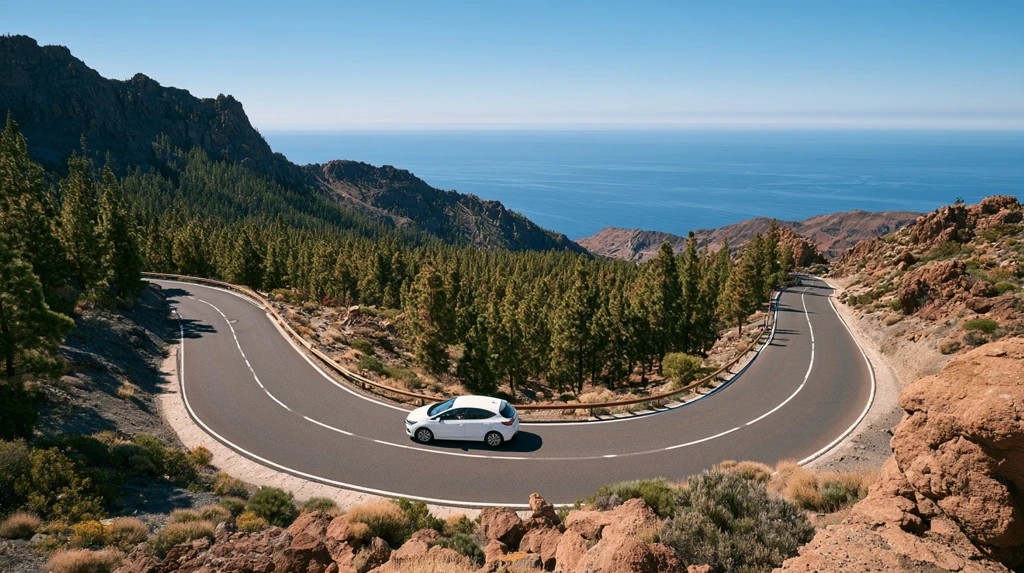
Hiring a car in Tenerife is the easiest way to explore Mount Teide, Masca, Anaga and the north coast, and it is usually affordable outside peak weeks, often from around €15–50 a day. You drive on the right, Spanish traffic law applies, and most visitors can use their home licence, though drivers from outside the EU and UK may need an International Driving Permit.
If you’re mostly staying put in a resort, you may only need a car for a few days of your trip.
What you need to hire a car
- A valid driving licence. EU/EEA and UK licences are accepted for visitors. US, Canadian, Australian and most other non-EU licences should be accompanied by an International Driving Permit.
- Passport or national ID card.
- A credit card in the main driver’s name for the deposit. Some firms accept debit cards with conditions.
- Minimum age: typically 21, with surcharges for under-25s. Check the small print.
Choosing a rental
Tenerife has the big international brands and well-established local firms, with desks at both airports and in the main resorts. When comparing:
- Fuel policy: “full-to-full” is usually fairer than prepaid tanks.
- Insurance excess: decide whether you want zero-excess cover, either from the rental firm or a separate excess policy.
- Automatics are in shorter supply and cost more, so book ahead.
- Inspect the car and photograph any damage before you drive away.
Key Spanish driving rules
| Rule | What applies |
|---|---|
| Side of the road | Right |
| Speed limits | 120 km/h motorways; 90 km/h most other roads (100 where signed); 50 km/h in towns, 30 km/h on single-lane urban streets, 20 km/h on shared streets |
| Drink-driving | 0.5 g/l blood (0.25 mg/l breath); 0.3 g/l (0.15 mg/l breath) for drivers under two years |
| Mobile phones | Handheld use is banned; fines are around €200 |
| Seat belts | Compulsory front and back |
| Children | Children under 135 cm must use an approved child restraint |
| Breakdown kit | Spanish-registered cars must carry a V-16 warning beacon from 2026; a reflective vest is also standard |
Police carry out regular checks, and on-the-spot fines are common. Drug testing by saliva swab is routine. Limits and penalties can change, so check the DGT (Spain’s traffic authority) for the latest.
The V-16 beacon
Since 1 January 2026, Spanish-registered vehicles, including hire cars, must carry a connected V-16 emergency light, which you place on the roof if you break down. It replaces warning triangles for Spanish cars. Your rental company should supply one; ask where it is kept.
Driving conditions in Tenerife
Motorways
The TF-1 runs along the south and east coast from Santa Cruz to Costa Adeje and on towards Guía de Isora, and the TF-5 links Santa Cruz with La Laguna and Puerto de la Cruz. Both get busy at rush hour, particularly near Santa Cruz and La Laguna.
Mountain roads
Roads to Mount Teide, Masca and Anaga are where you need care. Expect hairpin bends, steep gradients, narrow stretches, cyclists and tour coaches. Use a low gear on long descents to avoid overheating the brakes. The road down to Masca village is notoriously narrow, and access is sometimes restricted at busy times, so check before you go. Our Masca guide has more.
Weather
Teide can be cold, cloudy or even snowy in winter, while the coast is warm. Occasionally roads into the national park close because of ice or snow. Check conditions before setting off; see Tenerife weather by month.
Parking
- Blue zones in towns and some resorts are pay-and-display or app-based, with time limits.
- Yellow lines mean no parking.
- Hotel parking is often extra. Ask before you book.
- Busy spots such as Los Gigantes, Garachico and the Teide car parks fill early, especially at weekends.
Never leave valuables visible in a parked car, particularly at viewpoints and beach car parks.
Fuel
Petrol and diesel are usually noticeably cheaper in the Canary Islands than in mainland Spain because the islands have their own lower tax regime. Most stations take cards; some are self-service. Fill up before heading into the mountains, as stations are sparse at altitude.
Drinking and driving
Spain’s limits are lower than in some countries, and the police take them seriously. If your plans include a night on the Veronicas strip or a tribute show, leave the car at the hotel and use a taxi instead.
Do you need a car?
- Yes, for a few days if you want to see Teide, Masca, the north coast and quieter beaches.
- Not really if you are staying in Los Cristianos, Las Américas or Costa Adeje and mainly enjoying the beach and the evening entertainment.
Not sure? Read getting around Tenerife to compare cars, buses and taxis.
Frequently asked questions
Can I drive in Tenerife with a UK licence?
Yes. Visitors can drive in Spain on a valid UK photocard licence. EU and EEA licences are also accepted. Drivers with licences from many other countries, including the US, Canada and Australia, should carry an International Driving Permit alongside their licence.
What side of the road do they drive on in Tenerife?
Tenerife drives on the right, as in the rest of Spain. Hire cars are left-hand drive, and most are manual unless you request an automatic.
What is the drink-driving limit in Tenerife?
The standard limit is 0.5 g/l of alcohol in the blood (0.25 mg/l in breath), and 0.3 g/l (0.15 mg/l breath) for drivers with less than two years' experience. The safest choice is not to drink at all if you are driving.
Is it hard to drive up Mount Teide?
The main roads into Teide National Park are well surfaced but long and winding, with steep drops in places. Take it slowly, use lower gears on the descent and avoid driving it tired.
How old do you have to be to hire a car in Tenerife?
Most rental companies require drivers to be at least 21, with a young-driver surcharge often applied under 25. Many also ask that you have held your licence for at least a year or two.